

A corporate holiday-party shuttle is only useful if it gets guests to the event comfortably and gives them a workable journey afterward. Start with who is traveling, where they begin and where they need to finish. A shared ride back to the office may suit some employees, while others need a hotel, transit connection or a separately arranged local return.
Build the plan around the guest mix
A departmental dinner, company-wide gala and client hospitality event have different needs. Employees may start at the office, clients may join from a hotel and partners may travel independently. Count riders for each leg instead of using the event’s total attendance.
Ask guests which departures and returns they expect to use. Decide whether places must be reserved and who updates the list. A transport plan based on actual responses is more useful than hiring the largest vehicle and hoping everyone fits the same route.
| Guest group | What to establish | Useful arrangement to compare |
|---|---|---|
| One office team | Release time, loading entrance and after-hours access | One outward departure with specified returns |
| Several offices | Separate rider demand and travel time | Dedicated vehicles or an assessed multi-stop route |
| Visiting clients | Hotel, host and final destination | A small group movement with a named host |
| Large gala | Arrival window and early/final return demand | Multiple vehicles or timed waves where feasible |
The return should support the company’s actual event policy
Decide how people complete the journey after the final drop-off. If employees leave cars at the office, do not assume a bus ride makes every person ready to drive afterward. Coordinate appropriate onward arrangements with your own event team and communicate the options clearly.
For a transit connection, check the service needed on the actual date and allow time to reach it. A drop-off near a station is not the same as a guaranteed connection. Tell guests what happens if the event finishes later than planned.
For hotel guests, specify the hotel entrance and who is riding. For separate local returns, include the addresses or arrangements in advance. Several new home stops can materially extend the service and should not be improvised after the awards ceremony.
Offer early and final returns where useful
An early wave can suit guests with other commitments, while a final wave serves those staying through the program. Calculate the whole out-and-back cycle before assigning both to one vehicle. A bus on a long office return cannot simultaneously collect guests at the gala.
Label departures by destination and time, and ask guests to choose a wave. If capacity or timing requires two vehicles, quote that explicitly rather than promise unlimited flexibility.
Office-to-Manhattan holiday dinners
For a NJ office departure, confirm the building entrance, security instructions and permission to load. Give employees time to leave desks and reach the vehicle. A pickup immediately after a meeting needs a release time the meeting host can actually support.
For the Manhattan arrival, send the exact restaurant or event entrance to reservations. A private dining room, rooftop and theater may use different access arrangements. The venue coordinator should provide current commercial-vehicle instructions.
Allow for unloading, a walk and check-in before the program. Do not announce door-to-door access to every guest without checking the actual arrangement, especially if anyone needs assistance or reduced walking.
For a dinner and performance, our Broadway group guide explains how to protect curtain time. A holiday dinner on its own should not be burdened with additional stops unless they are part of the agreed event.
Hudson waterfront and suburban NJ events
For Jersey City, Hoboken, Weehawken or Edgewater venues, distinguish the office loading point from the event entrance. Nearby towns are not interchangeable travel estimates. Ask the operator to assess the actual address pair and time of day.
For a Morristown, Montclair, Red Bank or other NJ dinner, select a venue that can confirm the complete party and service window. A group menu, private room or activity reservation is separate from the vehicle booking. Our NJ downtown guide offers starting ideas.
For an interactive afternoon followed by dinner, share both reservations. Include the activity’s check-in, finish and group regrouping before the restaurant transfer. Do not assume every venue is ten minutes from the next stop.
Client entertainment and formal galas
Assign a host who can greet clients and answer the phone during boarding. Give guests simple instructions and a named contact rather than asking them to find a vehicle from a general office address. If several vehicles are used, tell each guest which one serves their return.
For arena hospitality, confirm the actual event, ticket entrance and finish window. A private vehicle does not provide VIP entry or priority security. The MSG and Barclays Center guide covers event collection, and our North Jersey outing guide includes Prudential Center planning.
For black-tie events, describe clothing and access needs when comparing vehicles. Ask about the offered layout, entry steps, lighting and sound preferences. Do not assume an advertised interior feature is removable or that every fleet model is prepared in one universal ‘executive mode.’
Choose the vehicle for the movement
Compare 12–14, 24, 28, 30, 40 and 52-passenger options against riders on each leg. For a larger event, request a multi-vehicle or timed-wave proposal. A single listed party bus should never be described as carrying 100 or 150 passengers at once.
Ask whether the lounge layout suits your guests. A celebration vehicle may work well for a social evening, while another arrangement may better suit access, luggage or a quieter transfer. Confirm the exact vehicle and any features important to the event.
Tell reservations about mobility equipment, coats, gifts and work bags. Legal seating capacity does not establish storage. Follow your company’s rules for laptops and other work materials; do not treat the bus as a guaranteed secure office or leave valuables aboard on an assumption.
If you want a video or playlist, confirm the actual equipment and compatibility. Keep critical presentations out of a plan that depends on unverified mobile connectivity or screen inputs.
Allow time for the entire program and return
Write the service start and final arrival clearly. Dinner, awards, speeches, photos and collection all need time. A late finish can affect driver and vehicle availability, so confirm the extension procedure before the event.
| Example component | Illustrative allowance |
|---|---|
| Office loading | 20 minutes |
| Outbound drive | 75 minutes |
| Arrival and check-in | 25 minutes |
| Reception, dinner and program | 4 hours |
| Gathering and collection | 25 minutes |
| Return drive | 75 minutes |
| Total | 7 hours 40 minutes |
This example explains the arithmetic, not a local traffic forecast or fixed gala package. Replace the allowances with your addresses and venue schedule. If the program is longer, extend the proposed service or redesign the returns before invitations go out.
Procurement and finance: make the scope reviewable
Give reservations your documentation requirements and approval deadline early. Ask about itemized proposals, invoices, W-9 information, insurance documentation and any building-specific requirements. Do not assume every supplier can meet an unreviewed onboarding condition on the event day.
Compare quotes for the same riders, hours, stops and vehicle requirements. Clarify tolls, parking or staging, waiting, gratuity, overtime, deposits, cancellation and changes. A weekday event does not guarantee a lower price or a particular model.
Separate transport from catering, tickets and venue costs. If you compare individual travel reimbursements, use a realistic complete-trip estimate rather than a speculative surge fare. The administrative convenience of one plan may matter even when it is not the cheapest option.
For illustration, a hypothetical $2,400 charter for 40 riders is $60 per rider; for 30 riders it is $80. These are budgeting calculations, not corporate package rates. Our pricing guide explains the main factors.
Before invitations go out
Have the event team review the transport plan alongside the program. The invitation should say where the service begins, which returns are available and whether guests need to reserve a place. Make the last departure clear so nobody mistakes a scheduled shuttle for an on-demand service.
If the venue, finish time or attendance changes, update the operator and obtain a revised confirmation. Send the new instructions to guests through the same channel as the original plan. Keep one current version so hosts, security and passengers do not follow conflicting pickup times.
Event-day communication
Use one version of the run sheet with the loading point, departure, venue arrival, return waves and contacts. Name the person authorized to change the route or approve extra service. A finance approver and an on-site host can be different people.
Send guests a reminder with the exact meeting location and return options. Avoid exposing private contact lists or client details on public signs. At departure, count actual riders and resolve missing guests through the host rather than holding a vehicle in an unsuitable loading area.
Corporate holiday shuttle questions
Can the service be alcohol-free?
Specify the company requirement and confirm it in the service arrangements. Do not assume refreshments are supplied. Any adult beverage request needs the operator’s approval for the exact vehicle, route and ages.
Can the same bus provide two return waves?
Only if the complete movements fit. Ask for the cycle and capacity to be checked; another vehicle may be necessary.
What if speeches run late?
Follow the agreed extension process. Do not assume unlimited waiting or that overtime automatically guarantees an extension.
Where do we start?
Send the event date, venue, offices, riders, access needs and returns. Our corporate planning guide and NJ options help prepare the brief.
Compare Vehicles for Your Group
Explore seven vehicle options, then confirm the right layout and capacity for your group.

12–14 Passenger Black Mercedes Sprinter Party Bus
A compact option for a smaller traveling party.


30-Passenger Luxury Party Bus
Compare for a larger group traveling together.
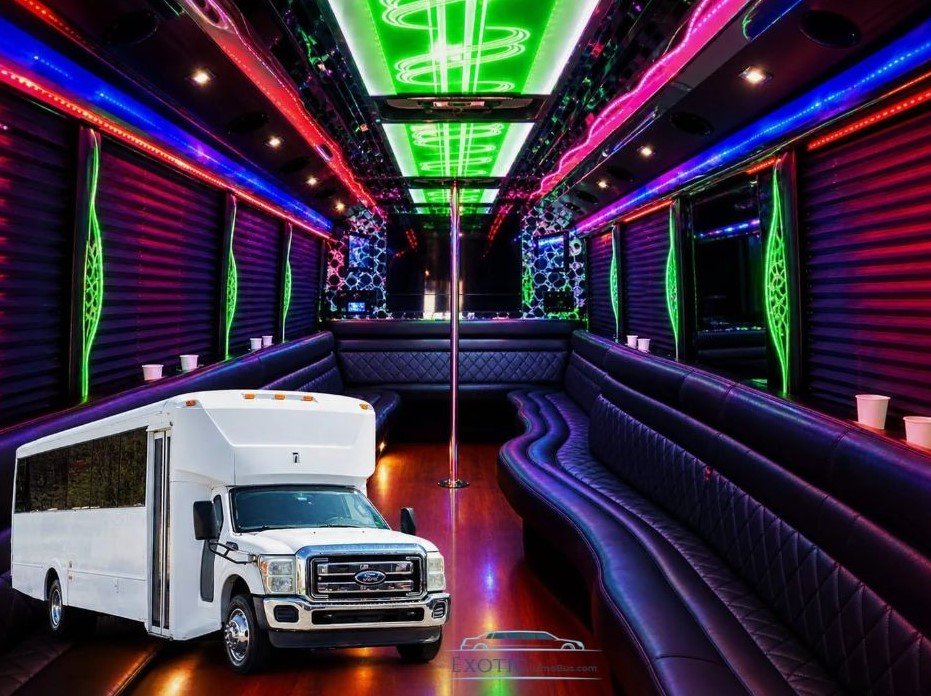
30-Passenger Party Bus With Pole
An alternative layout; discuss seating and trip requirements.

40-Passenger Luxury Party Bus
For larger groups; confirm the offered amenities.

52-Passenger VIP Club Party Bus
Compare for a large guest movement, subject to access.
Photos show fleet examples. Confirm the offered vehicle, legal seating capacity, amenities, luggage space and availability for your date. Tell us about accessibility needs before booking.
Request Your Holiday Party or Gala Transport Quote
Include the date, offices, venue, riders on each leg, program times, access needs, returns and documentation deadline.
Call (888) 534-8884. A request does not confirm a booking.
